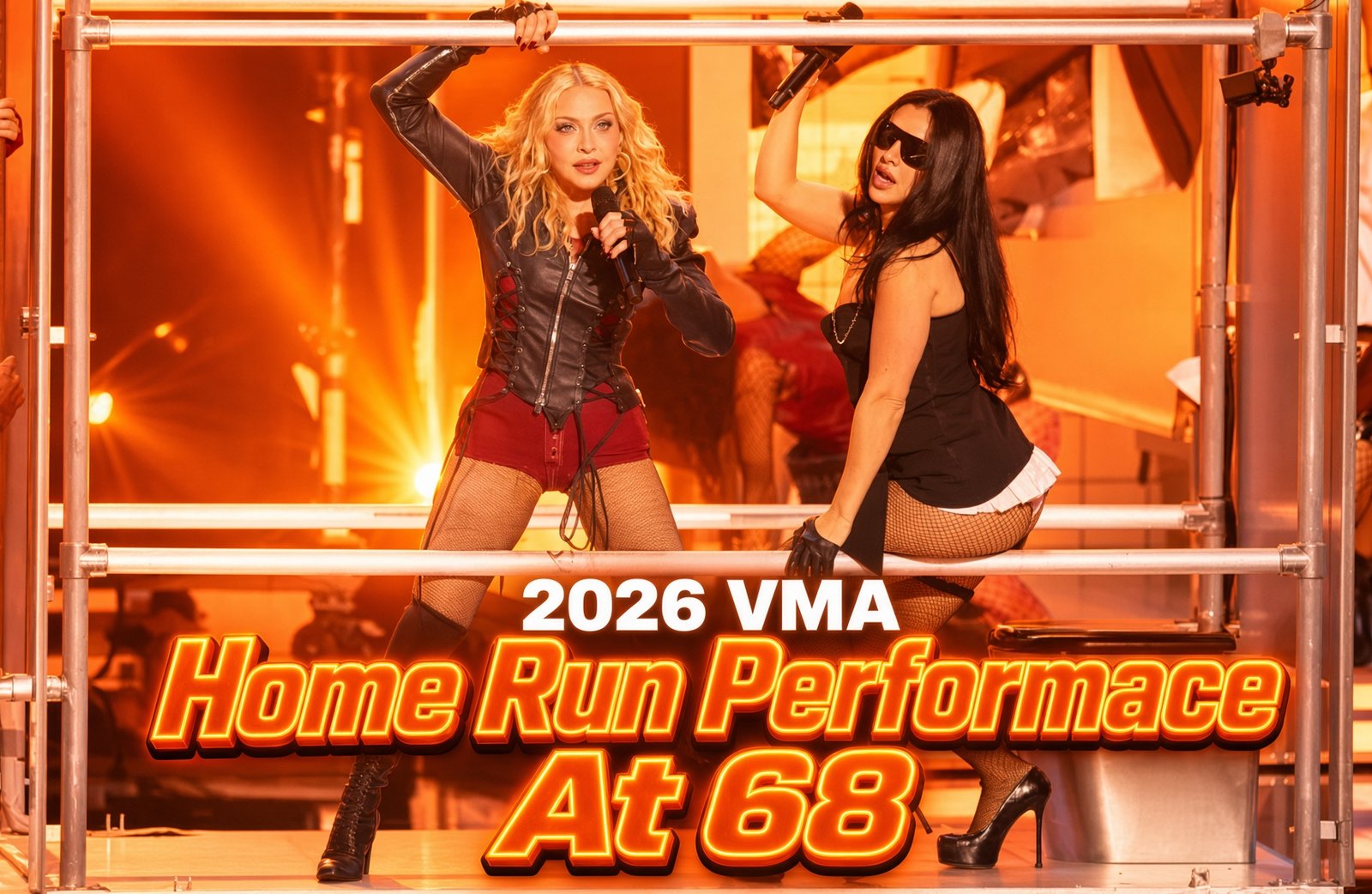
Madonna at the 2026 VMAs: At 68, She Still Does Whatever She Wants
answered it by letting her do the most Madonna thing available. She kissed Britney Spears and Christina Aguilera on this stage in 2003 and then stayed away for 23 years. She came back not as a legacy act singing “Like a Virgin,” but as the center of a new dance record, borrowing the two pop stars who currently own the lane she invented.
Madonna did not ease back onto the MTV Video Music Awards stage. On September 27, 2026, at the Peacock Theater in Los Angeles, she opened the show for the first time in 23 years, announced herself with “It’s mother…,” and spent the next eight minutes reminding a room full of younger stars who built this circus. Sabrina Carpenter was at the piano. Charli XCX walked out of a bathroom stall. Seth Rogen smoked a joint somewhere in the chaos. By the end of the night Madonna had seven Moonmen, including Artist of the Year.
She is 68. The interesting part is that the number never became the story. The performance did.
What actually happened in the opener
The medley came from Confessions II, the July 2026 sequel to Confessions on a Dance Floor. First up was “Bring Your Love,” the house-pop single with Carpenter. Madonna started spread-eagle on a black grand piano while Carpenter played underneath, then the two dropped into choreography as bondage-clad dancers doubled as steadicam operators. A platform carried Madonna across the stage. A choir in veiled white habits sang the chorus. She changed into red and writhed on a table ringed by that choir.
Then the set became the men’s room at Danceteria, the early-’80s New York club the song is named for. Charli XCX stepped out of a stall in shield sunglasses, fishnets, and a tight black dress, cigarette in hand, for “Danceteria Afterhours,” the remix released the week of the show. The bathroom had a hand dryer (a wink at Desperately Seeking Susan), a platform of dancers dressed as Madonna’s old eras, and a snatch of Lou Reed’s “Walk on the Wild Side.” Julia Garner, Debi Mazar, Sombr, and Andrew Watt popped through the frame. Rolling Stone later called the “Danceteria” half one of the great moments in VMAs history.
It was messy on purpose. The New York Times found the Carpenter section serviceable and a little disjointed, and said the night peaked once Charli arrived in the grimy club bathroom. That split is fair. “Bring Your Love” was the hit. “Danceteria Afterhours” was the thesis.
The 68-year-old problem that isn’t one
Every Madonna return gets the same preview question: should she still be doing this? The 2026 VMAs answered it by letting her do the most Madonna thing available. She kissed Britney Spears and Christina Aguilera on this stage in 2003 and then stayed away for 23 years. She came back not as a legacy act singing “Like a Virgin,” but as the center of a new dance record, borrowing the two pop stars who currently own the lane she invented.
Carpenter, in glitter shorts, played the eager collaborator and the punchline. Charli played the heir who already talks like the club never closed. Madonna played the only person in the building who does not have to ask permission. At 68 she was on her back on a piano, in a nun-choir fever dream, then in a nightclub toilet with a cigarette-flicking guest. CBS aired it. Nobody credible argued she had misread the assignment.
That is the actual privilege of the age. Younger stars still negotiate how much skin, how much joke, how much chaos a broadcast will tolerate. Madonna negotiated that in 1984, when she was told her career was over after she fell during “Like a Virgin” at the first VMAs. Four decades later she is still the one the show books to open, still the one who leads the nominations (13 this year), still the one who can make a bathroom set feel like a historical argument.
The speeches were the second performance
The wins piled up: Artist of the Year, Best Collaboration for “Bring Your Love,” Best Dance, Best Album, plus long-form, choreography, and cinematography honors tied to Confessions II and its film. She accepted several of them like someone who had not rehearsed and did not intend to. Accepting Best Collaboration, she told the room she waited five days for Carpenter’s team, got impatient, and DM’d her directly. They were in the studio within weeks. Carpenter laughed and recovered on mic. One account has her getting bleeped for saying her team was losing it backstage.
It was awkward, unprepared, and more famous by Monday than half the performances. That is also the point. Award-show gratitude is a genre. Madonna treats the podium the way she treats the stage: as a place where polish is optional and attention is not.
Who won the trio
Carpenter was precise. She hit the steps, sold the glitter, and gave the duet a center of gravity when the staging got busy. Charli was the spark. The stall entrance, the shades, the fishnets, the refusal to look impressed: “Danceteria Afterhours” is the clip people will still send around when the rest of the telecast has blurred. Snoop Dogg was the host. Madonna was onstage more.
Madonna did not out-dance either of them. She did not need to. She out-authored the night. The guests, the club-bathroom set, the old-era doppelgängers, the joint, the biopic joke with Julia Garner, the seven trophies: all of it only works if the room already agrees she can do whatever she wants. At 68, that agreement is the performance.